
Importing from Another Password Manager
Bring your credentials across from another password manager or browser. Ten sources are
supported, each with its own export instructions built into the extension.
Open Settings → Import Passwords.
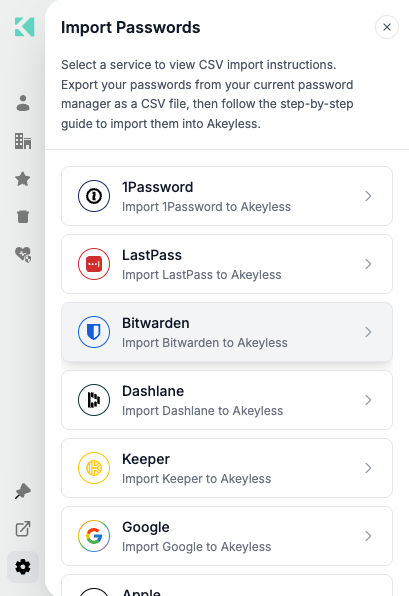
Choose the password manager you are moving from
Select a source to see its step-by-step export guide, then upload the CSV it produces.
Supported sources
| Source | How to export |
|---|---|
| 1Password | Desktop app → Export; instructions at 1Password Support |
| LastPass | the LastPass vault → Advanced Options → Export → confirm by email → re-enter your password |
| Bitwarden | Vault → Tools → Export vault; instructions at Bitwarden Help |
| Dashlane | Desktop app → My Account → Export data; instructions at Dashlane Support |
| Keeper | Vault → Export; instructions at Keeper Documentation |
passwords.google.com → gear icon → Export | |
| Microsoft Edge | edge://settings/passwords → Saved passwords → ⋯ → Export passwords |
| Apple | iPhone and Mac instructions at Apple Support |
| KeePass | File → Export → CSV File… (UTF-8 recommended) |
| Generic CSV | Any CSV with the columns below |
Generic CSV format
Columns: name, url, username, password, description (also accepted as note or notes).
| Behavior | Detail |
|---|---|
| Column order | Any — headers are detected automatically |
| Delimiter | Detected automatically (comma, semicolon, tab) |
| Encoding | UTF-8 preferred; common Western European (Latin) encodings also decode |
| Extra columns | Ignored rather than rejected |
The extension's own Export Passwords writes this format, so a file exported from one Akeyless
account imports into another unchanged. See Exporting Your Passwords.
KeePass default columns
A default KeePass export produces Account, Login Name, Password, Web Site, Comments.
These are recognized without renaming anything.
What happens on import
Each row becomes a password item:
| CSV column | Becomes |
|---|---|
name | The item name |
username | The username |
password | The password |
url | A website URL, which drives autofill matching and Launch |
description / note | The item description |
Imported items land in the area and folder you choose during the import. A folder path in the
name column, such as Work/GitHub, is recreated under the folder you choose.
The import summary
When the upload finishes, a summary reports how many rows were imported and how many were
skipped, so no row is dropped without a record.
Rows are usually skipped because they are missing a required field, or because the file could
not be decoded — see below.
Afterwards
Delete the exported CSV. It contains every password you just imported, in plain text,
sitting in yourDownloadsfolder. Empty yourTrashfolder too.
Then:
- Open Security Health and run a scan — an import is the
most likely moment to discover reused and breached passwords. - Check the imported items have website URLs, since autofill matches on them.
- Delete the credentials from the old manager once you have confirmed the import.
Troubleshooting
| Problem | Cause |
|---|---|
| Rows skipped | Missing name or password, or an unreadable encoding — re-export as UTF-8 |
| Accented characters mangled | The export used a non-UTF-8 encoding; re-export choosing UTF-8 |
| Nothing imported | The file is not a CSV, or has no recognizable header row |
| Autofill does not offer imported items | The rows had no url column — edit the items to add website URLs |
Related
Updated 3 days ago